
Conditioning for BJJ, MMA and combat sports: why more cardio is not enough
Combat sports demand more than the ability to run for a long time. Athletes need to produce force, repeat explosive actions, recover between exchanges, preserve technique under fatigue and make good decisions as their arms and legs tire. Conditioning should reflect those demands.
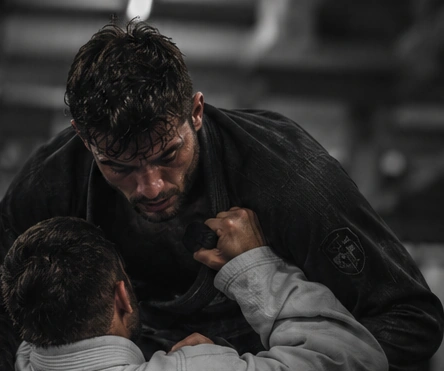
There is an extremely common phrase in fight gyms: “My cardio is finished.” It appears after an intense session of jiu-jitsu, a few rounds of boxing, wrestling or MMA sparring. The solution often seems obvious: do more cardio. Then the athlete starts running. More kilometers, more stairs, more bikes, more rounds on the air resistance bike.
It might work. But there is a problem: “cardio” is too broad a term to describe what happens in a fight. A fight is not a continuous race. It mixes periods of lower intensity with extremely aggressive explosions: takedown entries, scrambles, passes, submission attempts, escapes, combinations of blows, clinches, defenses, takedowns and lifts. Then the pace slows down. And a few seconds later everything can happen again.
A meta-analysis published in 2025, analyzing 20 studies in Olympic combat sports, found that HIIT programs improved VO₂max, peak power and average power. The benefits appeared both with general protocols, such as running, and with protocols using sport-specific movements. In 2026, another meta-analysis involving 14 randomized trials and 348 martial arts practitioners also found a relevant improvement in aerobic capacity, in addition to benefits in components of physical performance. This does not demonstrate that every protocol works equally nor that results automatically transfer to wins in BJJ or MMA.[1][2]
The message is not that every fighter should simply do HIIT. More interestingly, conditioning needs to develop the ability to produce intense actions repeatedly and recover quickly enough to do them again.
A fight uses several energy systems at the same time
It is common to try to divide training into aerobic or anaerobic. The body doesn't work as cleanly. Energy systems contribute in an integrated manner; what changes is their relative participation.
During a short explosion — a fall, a scramble or a combination — there is a huge contribution from the pathways that make energy available quickly. During longer periods, aerobic metabolism plays an important role in sustaining work. And one of its functions in combat sports is to help the athlete recover between intense efforts, including the resynthesis of phosphocreatine.[1]
Therefore, an excellent aerobic engine does not replace power. And power without recovery capacity also has limited utility. The athlete needs both.
BJJ shows this problem perfectly
Watch a round of jiu-jitsu. Not all seconds have the same intensity. An athlete may spend a certain period of time controlling position. Then he needs to prevent a sweep, enter a scramble, try to pass, defend a catch, explode to get out of a position and return to an apparently slower phase.
Temporal analysis studies of BJJ competitions have demonstrated this intermittent characteristic. In one investigation, high-intensity actions lasted approximately four seconds, inserted into much longer periods of less intense effort. After the fighting there was also a significant reduction in handgrip strength. This is a description of that sample and that competitive context, not a universal proportion for every fight.[4]
This shows two things. First, BJJ is not continuous maximal effort. Second, even though it doesn't feel like a traditional sprint, repeated actions can produce significant localized fatigue, especially in the arms and grip.
“Gas” is not a single capacity
When someone says “I’m out of gas”, the problem can be completely different depending on the athlete.
Athlete A: extremely high breathing, high heart rate and difficulty recovering. There may be a cardiorespiratory limitation, but heat, anxiety, excessive rhythm and other factors also need to be considered.
Athlete B: breathes reasonably well, but forearms are completely fatigued. Perhaps the main limitation is localized muscular grip resistance or unnecessary use of maximum strength.
Athlete C: still has energy, but can no longer explode in scrambles. The difficulty may be related to the ability to repeat high-power actions.
Athlete D: physically looks reasonable, but his technique deteriorates drastically as the fight progresses. Perhaps there is a lack of technical experience under pressure, specific ability or better pace management.
These examples are analytical hypotheses, not diagnoses based on symptoms. Calling all problems “cardio” eliminates important information.
The aerobic system lets you get back to attacking
It's easy to associate aerobic fitness with long, slow runs. For combat athletes, its importance goes beyond that. Imagine two ten-second explosions separated by a short period. The first may depend heavily on anaerobic energy production, but, during recovery, the organism needs to restore conditions to repeat the action.
That's why developing an aerobic base doesn't turn a fighter into a marathon runner. It can allow you to recover better between scrambles and rounds, control intensity better and reproduce quality actions for longer. The 2025 review found improvement in VO₂max in HIIT interventions lasting at least four weeks. A higher VO₂max, however, does not win the fight alone: it provides the capacity to sustain other capabilities.[1]
The problem with turning every session into HIIT
If HIIT works, would it make sense to do a lot of HIIT? Not necessarily. The athlete already receives interval efforts within the sport itself: sparring, rolling, bag rounds, wrestling and intense drilling. All this adds burden.
Now imagine a week with heavy BJJ on Monday, HIIT on Tuesday, heavy BJJ on Wednesday, sprints on Thursday, sparring on Friday and circuits on Saturday. There are six excellent sessions on paper. In the body there is almost an entire week of high intensity.
The problem may stop being a lack of conditioning and become a lack of recovery. An observational study of MMA athletes documented limitations in load distribution and management, reinforcing the need to look at the organization of the week, not just the isolated session.[7]
High performance does not require making each session difficult. It requires organizing difficult sessions in a way that the athlete can adapt to them.
General or specific conditioning?
Is it better to run, cycle, use a rowing machine, use an air resistance bike, do a circuit or simply fight more? The answer depends on the problem. The 2025 meta-analysis found improvements with general modalities and with movements specific to combat sports. This allows you to separate two useful tools.[1]
General conditioning: bike, run, rowing, SkiErg and other disciplines. The advantage is controlling intensity and volume without necessarily adding so many technical repetitions of the fight.
Specific conditioning: takedowns, entries, sprawls, strikes, passes, drills and specific rounds. The advantage is greater proximity to the competitive task. The cost may include more load on the fingers, neck, shoulders, knees and other structures already required by the sport.
More specific does not automatically mean better. The best stimulus is one that develops the necessary capacity at a cost compatible with the rest of the program.
Sometimes the bike is better precisely because it doesn't feel like a fight
Imagine a BJJ athlete training five times a week. To add conditioning, perhaps doing another 30 minutes of sprawls and entries is not necessary. A bicycle can develop cardiovascular capacity with a different stress distribution than on the mat.
This is a programming application, not a guarantee of no overhead. The bike still demands legs, energy and recovery. But it can allow you to work on a skill without exactly repeating the exposure that already dominates the week.
The best complementary exercise is not always the one that most resembles the modality. Sometimes it is precisely the one that develops the desired capacity without adding excess to what the sport already provides.
Strength remains fundamental
Imagine two athletes with the same technique. One of them is significantly stronger. For a comparable external task, the weaker athlete may need to utilize a greater percentage of their maximum capacity. An action representing 60% of maximum force is not equivalent, in relative effort, to the same task representing 40%. This doesn't allow you to directly calculate the cost of a fighting position, but it helps you understand why raising the force ceiling can be useful.
A systematic review of strength training in Olympic combat sports included 20 studies and 504 athletes. The programs produced improvements in maximum strength, isometric strength, power and some specific tests for sports such as judo, boxing, karate and wrestling.[3]
Physical preparation for fight should not just mean metabolic conditioning. An athlete needs strength, power, muscular endurance, aerobic capacity and the ability to repeat intense efforts.
But getting stronger doesn't solve everything either.
An athlete can have excellent deadlifts, strong squats, heavy barbells, and impressive grips, and still tire quickly on the mat. Maximum strength and ability to repeat contractions are related but different adaptations.
Imagine someone being able to hold an extremely strong grip for five seconds. Now ask to repeat this dozens of times or maintain partial contraction for several minutes. The problem has changed. Grapplers need not only grip strength, but also endurance, coordination and the opportunity to relax their muscles between actions.
Your forearms also impose a local limit
This explains a classic feeling in BJJ: the athlete is not completely tired, but can no longer close their hand. Studies show a drop in grip strength after combat, and repeated confrontations can increase accumulated fatigue.[4][5]
A randomized study published in 2026 investigated a complementary circuit strategy called Grappler Quest. The greatest effects were observed in strength endurance tests involving bench presses and squats with 50% of body mass. Improvements also appeared in measures of grip strength and endurance. The authors recommended caution with secondary outcomes given the multiplicity of tests.[5]
The study does not prove the universal superiority of the circuit nor does it demonstrate, alone, an improvement in the results of competitions. Its most defensible application is to reinforce that conditioning for grappling includes local muscular capacity, not just the heart and lungs.
Gi and No-Gi are not exactly the same demand
Even within BJJ, the specificity depends on the rules, equipment and the athlete's style.
With gi — Gi: grips in the fabric can create prolonged periods of isometric contraction.
No Gi — No-Gi: there are not the same footprints on the fabric; pummeling, body control, wrestling and scrambles can assume greater importance depending on the strategy.
Small comparative studies describe differences in some motor tests between groups, but do not authorize rules such as “every Gi athlete needs resistance” or “every No-Gi athlete needs explosiveness”. Both capabilities matter in both versions. The practical point is to assess actual demand rather than inferring the entire program from the uniform.
An athlete who repeatedly loses grips may need to pay more attention to local resistance. Another, very dependent on wrestling, may value power and repeated scrambles. The decision must be confirmed by performance and the coach.
And MMA adds another layer
MMA mixes grappling, wrestling, clinch, striking, takedowns, lifts and work against the fence. The athlete must perform these tasks wearing gloves and following specific rules.
Dynamometry research shows that the equipment can alter measured grip strength. The exact value depends on the test, glove and sample; it should not be treated as a fixed loss applicable to all fighters.
The important application remains: if the competition takes place under a certain equipment restriction, part of the technical preparation needs to take place under that condition. Specificity is not just imitating movements. It’s about preparing yourself for the real constraints of the task.
Technique under fatigue is different from conditioning without technique
An athlete can perform excellently on a bike, run or row and still quickly lose efficiency on the mat. Fighting requires decision. When he is tired, he needs to identify space, control position, choose attacks, react, save movement and anticipate the opponent.
Research on motor and cognitive tasks in BJJ practitioners is interesting, but differences in reaction tests or dual tasks do not, in themselves, demonstrate better decision-making during a tiring fight. To train this combination, it is necessary to observe technical tasks and specific conditions, with supervision and controlled intensity.
Physical conditioning and technical efficiency meet during the fight. The athlete who appears most conditioned is not always the one with the highest VO₂max. Sometimes it is the one that wastes the least energy.
Economy of movement also changes the “gas”
Watch a beginner. He often contracts muscles unnecessarily, holds grips with maximum force, tries to get out of positions using explosions, holds his breath and fights against forces that he could redirect.
Now watch an experienced athlete. He may appear to be doing less because he is: not necessarily less useful work, but less wasted work.
Improving technique can make the athlete appear more fit without a commensurate change in cardiovascular fitness. Therefore, when someone tires quickly, there are at least two questions: does he need to improve his physical capacity? And are you wasting energy unnecessarily? A good program considers both.
Not every round should be a war
Turning each session into a competition makes it difficult to control the load. If all rolling is performed at 100%, fatigue increases and technical quality and sustainable volume may suffer.
Some rounds can be competitive. Others may be technical, position specific or start in unfavorable situations. This allows you to manipulate the stimulus without relying solely on “fight harder”.
It's similar to the difference between easy running, intervals, and sprints. The runner does not need to compete every day. Neither does the fighter.
How to Structure Conditioning for a Fighter
A simple organization begins by separating capabilities, without forgetting that they interact.
Aerobic base: sustain work and recover. It can be developed with cycling, running, rowing, inclined walking or low-intensity technical work.
Power: producing very intense efforts with quality. Short sprints, bike, sled and explosive movements can be tools, depending on the athlete's objective and preparation. The pause must allow the desired quality.
Ability to repeat efforts: produce intense actions with incomplete recovery. You can use specific intervals or rounds, without confusing this objective with maximum speed.
Maximum Strength: Increase your force production ceiling with squats, hip patterns, pulls, pushes, and loaded movements.
Localized muscular resistance: working grip, forearms, trunk and other demands. Neck training requires careful selection and appropriate supervision; It is not an indication for cervical bridges or improvised loads.
Technique under fatigue: rounds, sparring and specific tasks with controlled load. No single bike session completely reproduces this.
An example week
Consider a recreational/intermediate BJJ athlete training four times a week. A possible organization would be:
| Day | Illustrative organization |
|---|---|
| Monday | Moderate technical BJJ and strength with controlled volume, preferably in separate periods when feasible. |
| Tuesday | More intense BJJ, with specific rounds and competitive rolling. |
| Wednesday | Comfortable aerobic for 30–50 minutes in a tolerated modality. |
| Thursday | BJJ and small volume of power. When the priority is explosive quality, perform power before important technical fatigue or at another period. |
| Friday | Complementary strength training, adjusted to the accumulated response. |
| Saturday | BJJ or simulation when appropriate to the calendar. |
| Sunday | Rest or light recovery. |
This is neither a universal prescription nor an obligatory starting point. There are several sessions in a week: a beginner or someone short on time may need much less. A professional competitor can train more. MMA needs to accommodate striking and wrestling. Anyone who works 40 hours has other recovery options. Logic matters more than the spreadsheet.
Five mistakes that harm conditioning
1. Do every workout until exhaustion. Fatigue is part of training; Constant exhaustion doesn't have to be the goal.
2. Confusing long runs with complete conditioning. Running can develop an aerobic base, but it is no substitute for strength, power, localized endurance and specificity.
3. Add HIIT to five days of heavy sparring. Perhaps we need to organize the existing intensity, not add more.
4. Only train what appears in the fight. General exercises can develop capabilities with a different distribution of articular and technical costs.
5. Measure conditioning through suffering. Sweat, nausea and exhaustion are not adaptation measures.
How do you know if your conditioning is improving?
Don't just rely on a vague impression. Observe the same number of rounds with lower RPE, less drop in performance between the first and last, faster recovery, greater quantity of quality actions, better grip maintenance and less technical deterioration.
These comparisons require context: partners, positions, duration, intensity, temperature and food change the meaning of the result. Five light rounds are not equivalent to five competitive rounds.
In 2025, researchers published data on the validity, reliability and sensitivity of a specific cardiorespiratory test for BJJ. This represents the search for evaluations closer to the sport, not the obligation for every practitioner to carry out laboratory tests. The test should reflect the question we want to answer.[6]
VETOR and the problem of the athlete who does everything
Combat sports pose a prescription challenge. A practitioner can perform BJJ, weight training, running, sparring, mobility, cycling and wrestling in the same week. If each activity is treated in isolation, everything seems reasonable. The organism, however, receives the combination of exposures.
VETOR’s proposal is to organize training considering context, not just “today there are six rounds”. What happened yesterday? Is there lower limb strength tomorrow? How many intense stimuli have there been? Is the athlete developing strength or maintaining it? Are you in the competition phase? Does it have limitations? How did you respond to the last training sessions? What is your availability?
The goal is to avoid good isolated workouts that, when combined, form a bad week. This describes a product logic; the availability of each feature and integration needs to be checked in the version used.
Adaptive conditioning is more interesting than “cardio of the day”
Imagine a plan with 6×3 minutes of intense work. The day before, the athlete did a very heavy rolling and reported higher-than-expected effort. A rigid system repeats the prescription. A contextual system might consider this session as part of the week.
Maybe maintain the training, reduce volume, replace it with light aerobics or preserve only part of the stimulus. The decision depends on the objective and the information available, not on an automatic rule that transforms all tiredness into rest.
The opposite also applies. If the athlete performs the rounds comfortably, recovers well and stops progressing, perhaps the stimulus needs to change. Prescribing is deciding when to increase, maintain, modify or remove stimuli.
VETOR doesn’t need to guess who has “good cardio”
It can help you track trends. Imagine five rounds with RPE 9 in the first week and a big drop after the third. Six weeks later, under comparable conditions, the same five rounds appear with RPE 7 and stable performance. That's a useful sign.
Now imagine that in week ten the RPE returns to 9, strength drops, sleep worsens and so does performance. The answer may not be more conditioning. There may be accumulated fatigue or another problem that requires investigation.
None of these combinations closes the diagnosis. They help you formulate better questions and decisions.
The best conditioning is the one that improves the fight
A fighter can have excellent VO₂max, high FTP, fast 10 km and fantastic sprint. Anything can be useful. But the ultimate goal remains to perform better in your sport.
Physical preparation needs to serve the maintenance of technique, repetition of explosive actions, strength, recovery and decisions. She must support the struggle, not compete with it.
Conclusion
Conditioning for BJJ, MMA, judo, wrestling and other combat sports is not simply “doing more cardio”. These modalities combine aerobic and anaerobic demands, strength, power, muscular endurance and repeated intense actions.
HIIT can improve aerobic and anaerobic capacity; strength training also has benefits; and grip fatigue deserves attention in grappling. Structured complementary programs are tools, not substitutes for technical practice.[1][2][3][4][5][6]
The question shouldn’t just be “how do I get less tired?” It should be: “What ability is failing when I start to get tired — and what stimulus can improve it?”
VETOR — DON’T GUESS.
Fighting better doesn't just mean having more energy. It means having the right capacity at the right time: strength to produce, power to explode, aerobics to recover, endurance to repeat, technique to spend less and planning to make all of this coexist.
VETOR seeks to connect these pieces into a performance logic that considers modality, history, frequency, limitations, load and response to training.
Don't train just to get tired. Train to remain efficient when fatigue sets in.
Your goal deserves a plan.
Discover VETOR's proposal to organize training according to your routine and monitor progress.
References
- Yue F, Wang Y, Yang H, Zhang X. Effects of high-intensity interval training on aerobic and anaerobic capacity in olympic combat sports: a systematic review and meta-analysis. Frontiers in Physiology. 2025;16:1576676. DOI:10.3389/fphys.2025.1576676
- Cai M, Cai H, Liu C, Qi K. Effect of high-intensity interval training on aerobic capacity, physical fitness, and body composition in martial arts athletes: a systematic review and meta-analysis of randomized controlled trials. Frontiers in Nutrition. 2026;13:1792680. DOI:10.3389/fnut.2026.1792680
- Herrera-Valenzuela T, et al. Effects of Strength Training on Physical Fitness of Olympic Combat Sports Athletes: A Systematic Review. International Journal of Environmental Research and Public Health. 2023;20(4):3516. DOI:10.3390/ijerph20043516
- Andreato LV, et al. Physiological and Technical-tactical Analysis in Brazilian Jiu-jitsu Competition. Asian Journal of Sports Medicine. 2013;4(2):137–143Full text on PubMed Central
- Wąsacz W, Rydzik Ł, et al. The Effect of the Experimental Training Program ‘Grappler Quest’ on the Motor Fitness of Brazilian Jiu-Jitsu Athletes. Journal of Clinical Medicine. 2026;15(13):5176. DOI:10.3390/jcm15135176
- Báez-San Martín E, et al. Validity, Reliability, and Sensitivity of the Brazilian Jiu-Jitsu Cardiorespiratory Fitness Test: A Methodological Approach Based on Combat Specificity. Applied Sciences. 2025;15(20):11124. DOI:10.3390/app152011124
- Kirk C, Langan-Evans C, Clark DR, Morton JP. Quantification of training load distribution in mixed martial arts athletes: A lack of periodization and load management. PLOS ONE. 2021;16(5):e0251266. DOI:10.1371/journal.pone.0251266
Educational content. Examples do not replace individual assessment and guidance from training and healthcare professionals.