Mobility and stretching for high performance: improving range of motion without losing strength or power
Range of motion, strength and control need to work together. Learn when to stretch, how to warm up and how to adapt mobility work to running, strength training, cycling and combat sports.

Does greater flexibility mean better performance?
Imagine two athletes. One reaches deep positions in passive stretches but loses control when squatting under load. The other has less passive range but can squat, accelerate and decelerate within the demands of their sport. Who is better prepared? The answer depends on the task.
Flexibility describes the available range. In sport, mobility generally includes using that range with control. The aim is not to reach the largest possible range in every joint, but to develop the capacity needed for the movements that matter.
1. Mobility, flexibility and stability
In a passive leg raise, another person helps you reach a position. This does not show that you can reproduce it actively or produce force there. In a squat, ankles, hips and other joints must work together; anatomy, the task and movement strategy change the range required.
| Capacity | Characteristic | Example |
|---|---|---|
| Flexibility | Available range | Hamstring stretch |
| Mobility | Using range in a task | Deep squat |
| Motor control | Coordinating movement | Controlling a lunge |
| Strength | Producing muscular tension | Loaded squat |
| Stability | Controlling mechanical demands | Holding a single-leg position |
These capacities interact. If you already have enough range but cannot control the load in that position, increasing flexibility may not be the priority. Strength and motor control may need more attention.
2. Static or dynamic stretching before training?
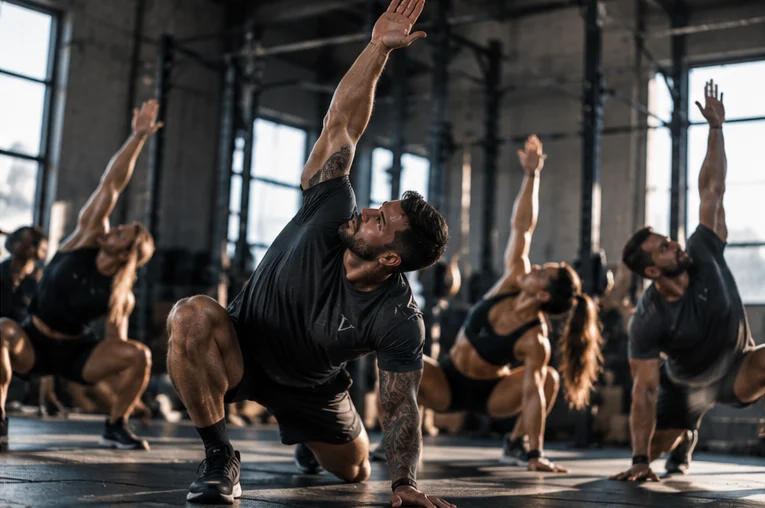
Static stretching holds a position, such as a calf stretch against a wall for 30 seconds. Dynamic stretching uses controlled movements such as lunges, knee raises and hip rotations. Both can develop range; the choice before training depends on duration, intensity and the next activity.
A 2024 meta-analysis included 16 studies: both strategies improved range. For vertical jumping, the individual effects were not statistically significant, but the direct comparison favored dynamic stretching. Prolonged static stretching immediately before explosive efforts can temporarily reduce performance; this does not mean banning all static stretching from warm-ups.[2]
3. Stretching afterward does not guarantee better recovery
Delayed-onset muscle soreness can follow unfamiliar effort, especially with substantial eccentric loading. It does not simply happen because a muscle became shortened. A Cochrane review of 12 studies found no clinically important reduction in soreness from stretching before or after exercise.[5]
Stretching can feel comfortable and contribute to flexibility over time. But it should not be sold as a way to automatically eliminate soreness or accelerate every recovery process. Developing range and recovering from training are different goals.
4. Resistance training can also develop mobility

A 2023 meta-analysis of 55 studies found range-of-motion gains with externally loaded resistance training. The comparisons analyzed found no statistically significant difference versus stretching. This does not make every exercise equivalent: selection, range used and individual capacity still matter.[3]
Squats and single-leg variations can develop strength in the ranges trained. There is no need to force extremes or start with heavy loads. The following example is illustrative for healthy adults, not a clinical protocol or universal prescription. Adjust load, rest and range to maintain control and comfort.
| Exercise | Sets | Repetitions | Goal |
|---|---|---|---|
| Goblet squat | 3 | 8 | Hip, knee and ankle control |
| Split squat | 3 | 8 per leg | Single-leg strength and range |
| Romanian deadlift | 3 | 8 | Hip and hamstring strength |
| Calf raise | 3 | 12 | Plantar flexor strength |
| Controlled thoracic rotation | 2 | 8 per side | Thoracic movement |
5. How does stretching change range of motion?
A 2025 review analyzed 65 studies and 1,542 adults. It found small reductions in passive stiffness after static stretching and greater stretch tolerance after repeated programs. Overall analyses found no significant change in muscle fascicle length. Improving range does not necessarily mean making a muscle permanently longer.[1]
You do not need to tolerate as much pain as possible to gain flexibility. Explore a tolerable sensation, progress gradually and do not force a joint beyond what you can control. Mechanical changes and changes in tolerance can both contribute to adaptation.
6. Mobility for your sport
In running, more flexibility does not automatically mean better economy: aim for sufficient range and control. In resistance training, requirements differ between squats and overhead movements, with anatomical differences taken into account. In cycling, mobility and strength complement preparation but do not replace necessary bike-fit adjustments.
Combat sports may require large ranges, but passive flexibility does not guarantee strength and coordination in those positions. In CrossFit and weightlifting, reaching a deep overhead squat does not mean being ready to move a heavy load. Skill needs to develop alongside physical capacity.
| Sport | Relevant regions | Practical priority |
|---|---|---|
| Running | Ankle and hip | Functional range and control |
| Resistance training | Depends on the exercise | Strength in appropriate ranges |
| Cycling | Hip, spine and ankle | Comfort and control while pedaling |
| Jiu-jitsu | Hips, shoulders and trunk | Active range and control |
| Muay Thai | Hips and lower limbs | Control in specific positions |
| CrossFit | Shoulders, ankles and hips | Integrating mobility, skill and strength |
These priorities are general, not diagnoses. The aim is to meet the activity’s demands, not to develop the greatest possible flexibility everywhere.
7. Dynamic warm-up: approximately 10 minutes
This example combines a gradual increase in activity, dynamic movement and specific preparation. It is intended for healthy adults without limitations that prevent these movements. Duration depends on movement speed, transitions and breaks; it is not a mandatory protocol for every session.
| Step | Exercise | Illustrative prescription |
|---|---|---|
| 1 | Brisk walking or easy cycling | 2 minutes |
| 2 | Ankle mobility | 10 repetitions per side |
| 3 | Controlled hip rotation | 8 repetitions per side |
| 4 | Quadruped thoracic rotation | 8 repetitions per side |
| 5 | Bodyweight squat | 10 repetitions |
| 6 | Alternating lunges | 6 repetitions per side |
| 7 | Activity-specific preparation | 2 minutes |
Walking or cycling gradually raises cardiovascular demand. Joint movements explore comfortable ranges; squats and lunges add control. Finish with preparation similar to the session: progressive drills for running, light sets for resistance training or controlled technical movements for combat sports. A warm-up should prepare you, not cause unnecessary fatigue.
8. How to organize four weeks of flexibility work
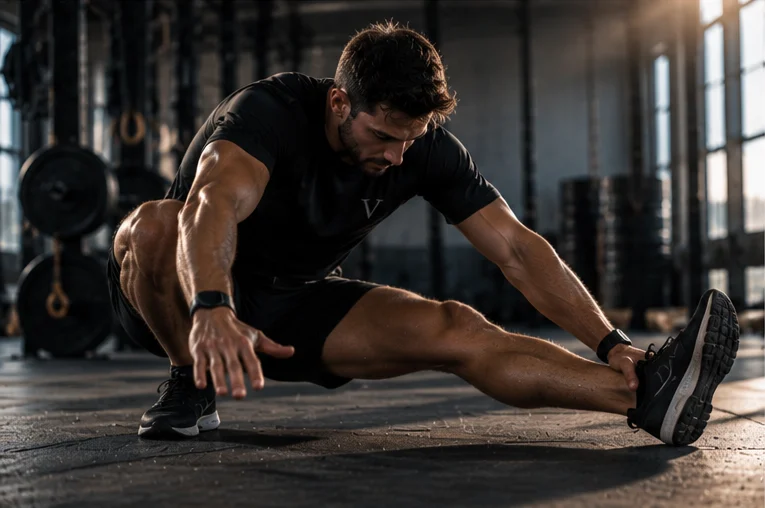
Someone who already has enough range may need little additional work. If a need exists, a supplementary session can target calves, hip flexors, hamstrings and chest according to the goal. An illustrative starting point is holding each comfortable position for 20–30 seconds for two sets. Progression is not required every week.
| Week | Goal | Strategy |
|---|---|---|
| 1 | Establish current range | Identify relevant, tolerable movements |
| 2 | Build consistency | Maintain exercises and frequency |
| 3 | Progress when appropriate | Gradually adjust duration or control |
| 4 | Reassess | Compare range and execution |
Use comparable conditions: position, load and execution. Consistency and relevance to the goal matter more than chasing range at any cost. Four weeks organize observation; they do not guarantee a specific result within that time.
9. Mobility and injury prevention: what can we say?
Greater flexibility does not automatically prevent injuries. Load, fatigue, exposure, physical capacity, history and the sport’s characteristics also matter. A 2002 BMJ review found no meaningful protection in the injury studies analyzed, which involved military recruits; that population limits generalization to all sports.[6]
10. Five common mistakes
- Chasing more range without connecting it to the task: greater flexibility does not always improve performance.
- Mistaking stretching for a complete warm-up: cardiovascular and specific preparation also count.
- Forcing intense pain: tolerable discomfort and pain are not the same thing.
- Using only passive stretching when the goal also requires strength and active control.
- Copying professionals with different demands: visual difficulty does not determine usefulness.
11. Do you need more range or more control?
If you can reach a position passively but cannot reproduce it actively, strength and control may be priorities. If limitation appears in both situations, a restriction may warrant investigation. These simple tests do not automatically identify the cause: anatomy, pain and other factors influence the result.
Track range, movement quality and relevant exercise performance. Squatting deeper with control and comfort can represent useful progress, but it does not prove that maximal strength increased. Assess the capacity the program was intended to develop.
12. How VETOR connects with mobility training
A lifter, a runner and a combat athlete do not need the same routine. The first may prioritize strength through exercise ranges; the second, dynamic warm-up movements; the third, control in specific positions. VETOR’s proposition is to connect goals, sports and training history to structure more individualized sessions.
This means selecting exercises for the goal, progressing when needed and integrating mobility into the main session. Someone with adequate range may need to prioritize strength; another person may benefit from additional flexibility work. Training history helps put decisions in context without treating every difficulty as a lack of mobility.
It would be inaccurate to claim that VETOR automatically measures joint range, diagnoses limitations or identifies injury risks without specific implemented and validated tools. The app does not replace professional assessment for symptoms or significant limitations. Intelligence means selecting appropriate stimuli, not prescribing more exercises for everyone.
The best mobility is the mobility you can use
Static stretching can develop range; dynamic movement can prepare the activity; resistance training can develop strength and range together. Immediate warm-up effects should not be confused with adaptations over weeks of training. A 2024 review of chronic static stretching found small or trivial effects on jumping and sprinting performance, providing no basis for promises of major sporting gains.[4]
VETOR — DON’T GUESS.
Your preparation deserves direction. Explore VETOR’s approach and follow the development of an experience connecting goals, sports and progression.
References
- Mechanisms of range-of-motion changes after static stretchingIngram et al. (2025) · Sports Medicine
- Static and dynamic stretching in warm-ups: range and jumpingEsteban-García et al. (2024) · Applied Sciences
- Resistance training and range-of-motion gains: meta-analysis of 55 studiesAlizadeh et al. (2023) · Sports Medicine
- Chronic static stretching and jumping and sprinting performanceKonrad et al. (2024) · Frontiers in Physiology
- Stretching to prevent or reduce muscle soreness after exerciseHerbert, de Noronha & Kamper (2011) · Cochrane
- Stretching before and after exercise: soreness and injury riskHerbert & Gabriel (2002) · BMJ
Educational content. Examples do not replace medical or physiotherapy assessment or individual training prescription. Images are illustrative and do not define a required range of motion.