
Open-water swimming: how to swim faster, build endurance and master long distances
From pool to sea, endurance alone is not enough. Learn to combine pacing, technique, navigation and safety when preparing for 1.5 km, 3 km, 5 km and 10 km, with sample sessions and scientific references.
Why pool performance does not always transfer to the sea
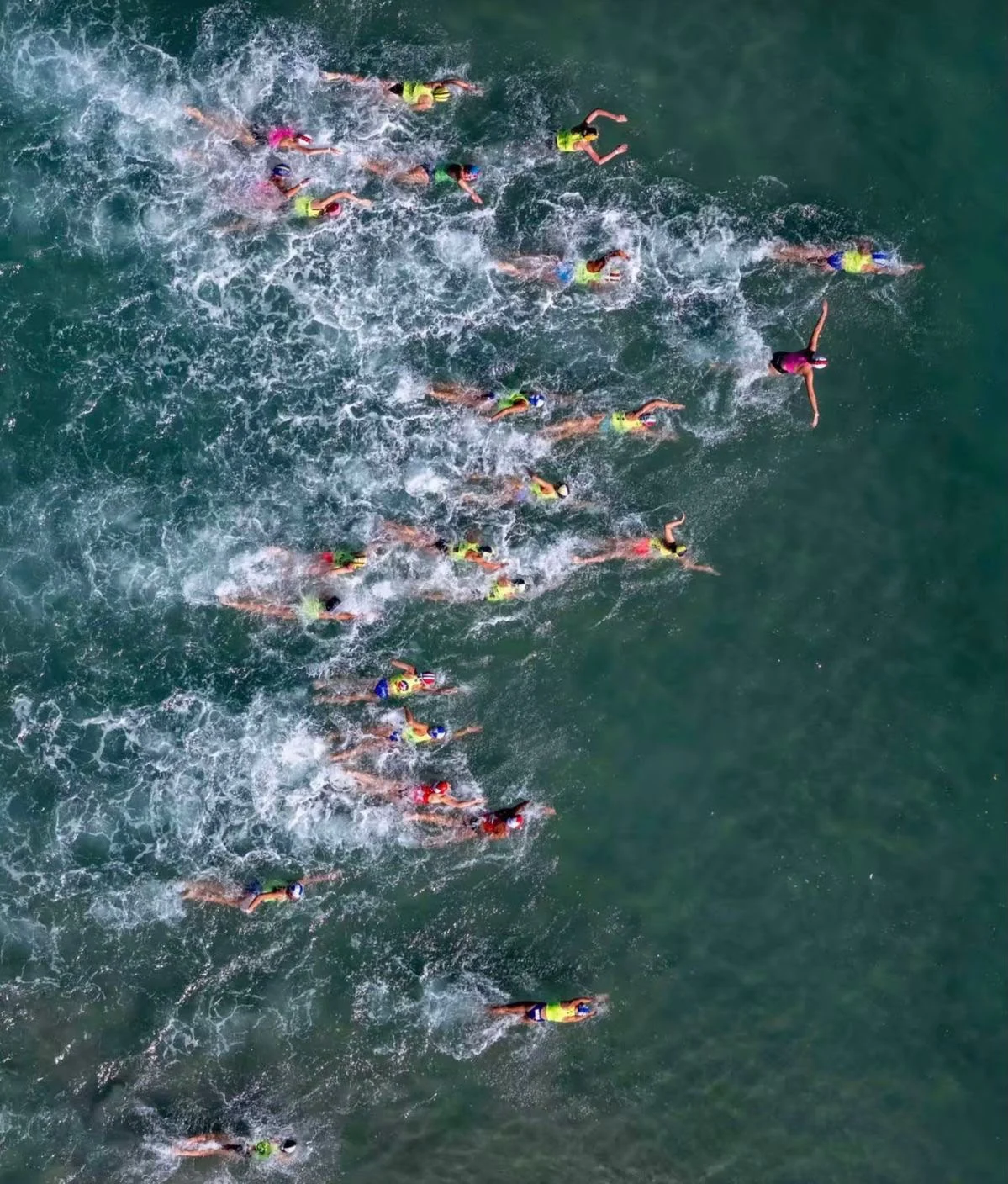
Imagine someone who swims 1,500 metres in a pool at a steady pace, following lane ropes and floor markings. In their first sea race, they encounter waves, poor visibility, currents and nearby swimmers. The route becomes longer, breathing needs adjustment and effort rises. Their fitness has not disappeared: the environment now demands skills they have not developed enough.
The review of elite 10-km swimmers, published online in December 2025 and in a 2026 issue, highlights physiological, biomechanical, tactical and environmental factors. Preparation needs to develop sustainable speed and efficient movement in changing conditions, rather than simply accumulate metres.[1]
1. What determines open-water performance?
Aerobic capacity supports sustained effort, but cannot guarantee speed without technique. Swimming 100 metres in 1min20s rather than 1min30s does not prove superiority over 5 km. Body position, coordination, propulsion and drag change the cost of every metre. Navigation determines the actual distance travelled; temperature, waves, wind and currents affect performance and safety. The importance of each ability depends on the event and experience.
2. Learn from elite swimmers without copying their volume
The review describes predominantly aerobic training, including an observed model with 76.83% at low intensity, 17.70% at moderate intensity and 5.47% at high intensity. These are study observations, not a universal prescription. The practical lesson is to vary session purpose: someone swimming three times weekly might emphasize endurance, sustainable speed, and technique with navigation in separate sessions. Three sessions are not automatically enough for every distance.[1]
3. Critical Swim Speed: a reference, not a promise
CSS estimates speed from the distance–time relationship. One protocol uses maximal 400- and 200-metre pool efforts, with sufficient recovery and times in seconds. The formula is CSS = 200 ÷ (400 m time − 200 m time), in metres per second. It is not an exact laboratory measure of lactate threshold and does not guarantee a sustainable sea pace.
| Test | Recorded time | Seconds |
|---|---|---|
| 400 m | 7min30s | 450 |
| 200 m | 3min30s | 210 |
In this example: 200 ÷ (450 − 210) = about 0.83 m/s, equivalent to 2min00s per 100 metres. A study of 32 national-level swimmers found good reliability for critical speed estimated from 200 and 400 metres, but other model variables were less reliable. Beginners who cannot yet complete the tests safely should develop continuous swimming and use suitable assessments rather than force maximal efforts.[3]
4. Starting fast does not guarantee finishing fast
Over 5 km, following a group above your capacity in the first 500 metres can cost you technique later. Practise steady pacing and check whether the last repetitions maintain the quality of the first. Finishing accelerations can be trained, but negative splits are not mandatory in every session. The aim is to distribute energy according to the task.
Pla and Bouvet monitored five elite swimmers in a 10-km race using GPS. They found differences in trajectories and intensity; the winner reserved higher efforts for later stages. This is a small exploratory study, not proof of a universal strategy or a causal link between a fast start and a worse result.[2]
5. Strokes: rate and distance work together
Speed depends on the interaction between stroke rate and distance per stroke. Adding strokes while each produces less displacement may not help. Overextending a stroke can also interrupt propulsion. Define whether you count each arm or full cycles, and track time, count, rate, perceived effort and coordination during 100-metre repeats. Lower effort with stable times and good execution may indicate progress; stroke count alone cannot measure total energy efficiency.
6. Navigation and breathing at sea
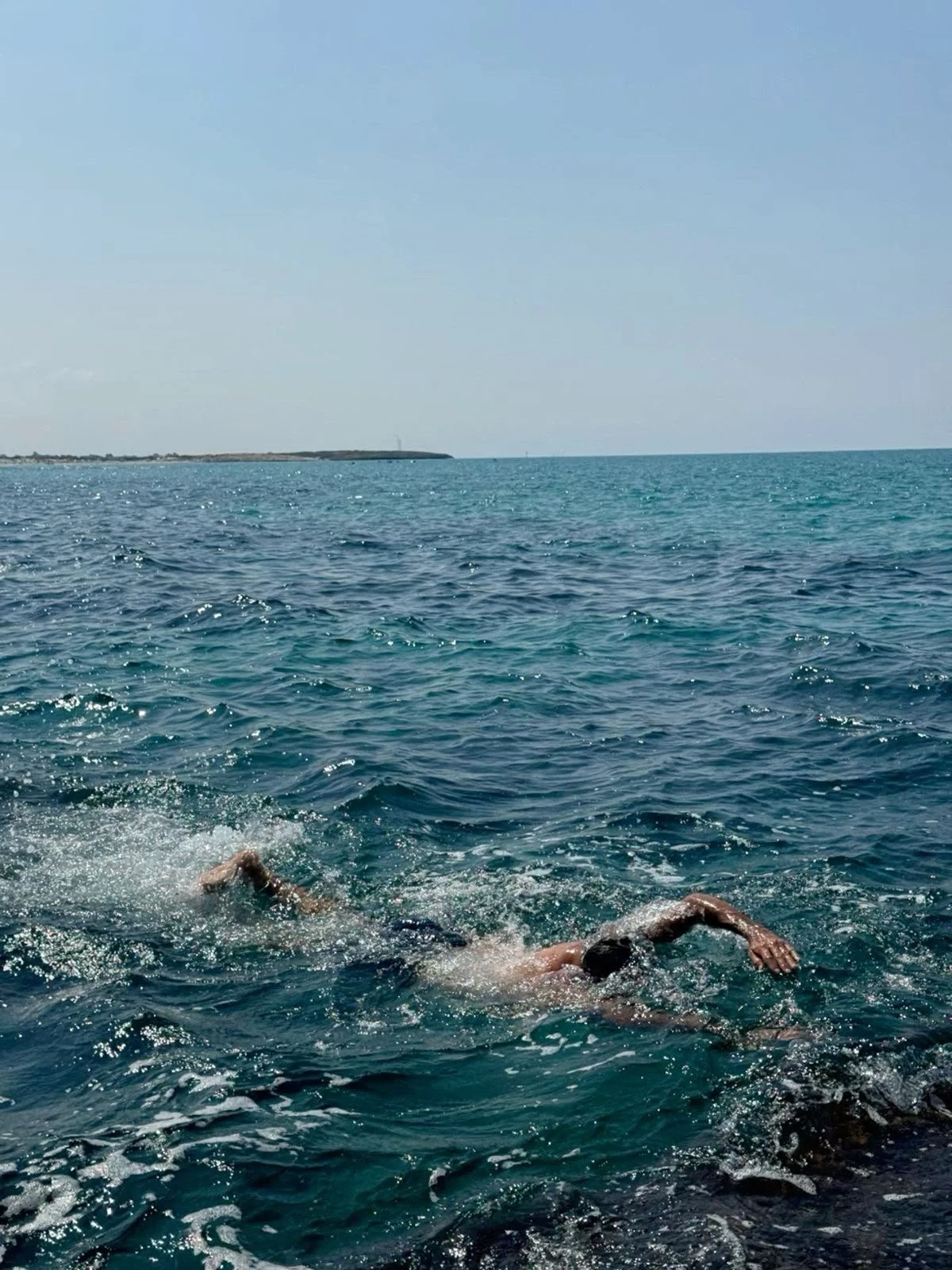
Sighting means briefly checking an external landmark to confirm direction. Lifting the head too far can increase drag; practise a short, controlled look. In the pool, use a fixed point and try 6 × 50 metres with periodic checks, adjusting frequency. USMS recommends practising this skill before races. Breathing comfortably to both sides helps with waves, wind and competitors, without requiring a breath every three strokes. Maintain adequate ventilation: do not use hyperventilation, breath-holding or oxygen restriction to simulate racing.[5]
7. Preparing for 1.5 km, 3 km, 5 km and 10 km
| Target distance | Preparation priority |
|---|---|
| 1.5 km | Continuity, pacing, technique and environmental adaptation |
| 3 km | Endurance, longer sets and navigation |
| 5 km | Efficiency under fatigue, pacing and feeding |
| 10 km | Long-duration endurance, strategy, support and recovery |
These priorities are general. For a first 1.5-km event, develop continuity with progressive sets; you do not need to swim the whole distance in every session. Over 3 km, technique under fatigue and sustainable speed become more important. Over 5 and 10 km, duration, navigation and support demands increase. The goal sets the direction; current capacity sets the starting point. Do not automatically copy Olympic volume.
8. Three practical sessions with different purposes
These educational examples are for healthy adults who already swim and have suitable experience. Adjust volume, intensity and rests with professional guidance. They are not learn-to-swim lessons or permission to enter the sea alone.
Session A — Aerobic base and consistency. Pool, intermediate level, 2,000 metres. Keep the 200-metre repeats consistent; 20–30-second rests are an adjustable starting reference.
| Step | Prescription | Intensity |
|---|---|---|
| Warm-up | 300 m | Easy |
| Technique | 6 × 50 m | Controlled |
| Main set | 6 × 200 m | Sustainable aerobic |
| Cool-down | 200 m | Easy |
Session B — Sustainable speed and acceleration. Pool, intermediate to advanced, 1,700 metres. For the 100-metre repeats, use around 20–30 seconds of rest according to ability. For the fast 50s, rest longer if needed to preserve technique.
| Step | Prescription | Intensity |
|---|---|---|
| Warm-up | 300 m | Easy |
| Preparation | 4 × 50 m | Progressive |
| Main set | 8 × 100 m | Moderate to high |
| Speed | 4 × 50 m | Fast, with technique maintained |
| Cool-down | 200 m | Easy |
Session C — Navigation and adaptation. For competent pool swimmers already familiar with open water, only in an authorized, supervised location with suitable conditions. Total: 30 minutes, including three one-minute recoveries between four blocks.
| Step | Prescription | Purpose |
|---|---|---|
| Entry and adaptation | 5 min | Become familiar with the water |
| Visual navigation | 5 min | Identify landmarks |
| Controlled swimming | 4 × 3 min | Maintain direction and pace |
| Recoveries between blocks | 3 × 1 min | Recover and check position |
| Finish | 5 min | Controlled return |
Keep the route near shore within the area assessed by the responsible team. If conditions worsen, cancel or move to the pool; navigation can also be practised entirely in a controlled environment. A watch must not determine how long you stay in hazardous water.
9. Complementary strength without compromising swimming
Greater gym strength does not guarantee more speed in water: it needs to be applied efficiently. Pulldowns or pull-ups, rows, squats, Romanian deadlifts, shoulder external rotation and trunk stability can be included according to experience and needs. They are not mandatory exercises or automatic shoulder-injury prevention. Consider fatigue from strength work and swimming together to maintain session quality.
10. Safety is part of preparation
Rip currents can carry even strong swimmers away from the beach. The National Weather Service advises against fighting the flow directly. If able, swim out following the shoreline and then return at an angle outside the current. If unable to escape, conserve energy, float and signal for help. Prevention comes first: follow lifeguards and warnings; do not enter dangerous conditions.[6]
A 2026 study of 20 trained swimmers in wetsuits found a median critical temperature near 15°C under experimental conditions, but supported retaining the conservative 16°C competition threshold discussed by the authors. This does not make 16°C safe for everyone. Duration, individual response and environment change risk; wetsuits do not eliminate cold shock or hypothermia. Do not replicate cooling protocols or expose yourself without supervision. Check current event rules and local guidance.[4]
11. GPS, pace and distance need context
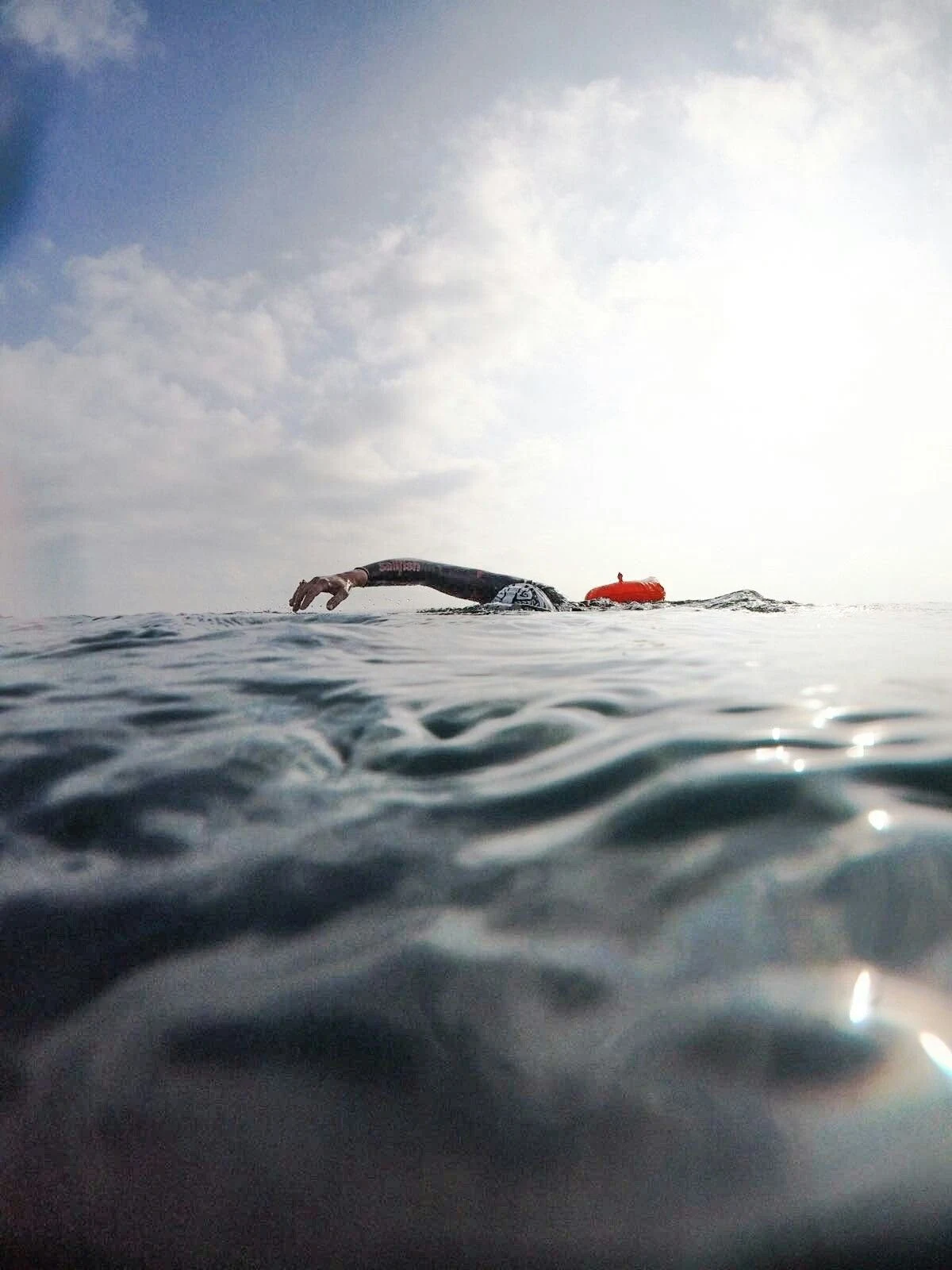
A watch reading of 1,500 metres at sea is not necessarily equivalent to 1,500 metres in a pool. GPS can be inaccurate, routes vary, currents help or hinder, and pool walls and turns are absent. Total time, pace, splits, heart rate, strokes, route and perceived effort provide different perspectives. Water-based sensors have limitations; strokes alone do not measure efficiency. Compare similar conditions and record the environment rather than treating every slower pace as lost fitness.
The GPS study used specific analytical methods with only five athletes. It shows potential for trajectory analysis, not automatic validation of every commercial watch or algorithm.[2]
12. Food and hydration in longer events
A short session and a long race have different needs. Before swimming, eat according to duration and intensity, avoiding prolonged efforts with insufficient energy. For long events, plan fluids and carbohydrates around tolerance, rules, feeding points and actual support. There is no single dose for every distance. Afterwards, food and hydration should meet daily needs; immediate supplements are not mandatory. Test the strategy during supported training, not only on race day.
13. Organize the week as one complete programme
An example for an intermediate swimmer targeting 1.5–3 km, with three swim sessions and two physical preparation sessions. Beginners may need fewer; competitors may need another distribution. Adjust strength work if it compromises the next swim.
| Day | Session and priority |
|---|---|
| Monday | Pool technique and aerobic base |
| Tuesday | Complementary strength training |
| Wednesday | Intervals for sustainable speed |
| Thursday | Recovery and fatigue management |
| Friday | General strength, adjusted to the next session |
| Saturday | Continuous swimming or supervised open water |
| Sunday | Rest |
14. Progress without increasing everything at once
For someone who already tolerates 1,500-metre sessions, four weeks can organize baselines, consistency, adjustments and assessment. First, record times, volume and effort. Second, repeat and improve consistency. Third, change one variable only if well tolerated. Fourth, compare results and reorganize priorities. Increasing in week three or reducing every fourth week is not mandatory. Duration, repetitions, speed, rests and technical complexity can change at different times.
15. Five mistakes that limit progress
- Adding kilometres without addressing technique, navigation or sustainable speed.
- Ignoring the route and swimming farther than necessary.
- Using only continuous swims, without relevant intervals or technical drills.
- Directly comparing pool and sea pace while ignoring the environment.
- Confusing fitness with protection from ocean hazards.
16. How VETOR connects with swimming preparation
Someone who swims 2,000 metres continuously and wants a faster 1.5 km does not need the same programme as someone swimming 500 metres and preparing for a first event. VETOR aims to connect goals, sports, history, prescription and progression with current capacity. For triathletes, swimming must coexist with running and cycling; strength training also contributes to total load. Struggling through a session does not automatically justify a harder one next.
Tracking depends on data that is actually available. We do not claim that VETOR already interprets currents, calculates ideal routes, analyses strokes by video or integrates with every sensor. Those functions require specific implementation and validation. Missing data does not mean missing effort, and slower sea pace does not prove declining fitness. Personalization also requires recognizing information limits.
17. What can science not yet establish?
There is no universal ideal intensity distribution or stroke rate. CSS depends on the tests; small GPS studies do not establish the best strategy for everyone; elite findings do not automatically transfer to beginners. The 10-km review shows that no single metric represents all of preparation. Use evidence to guide decisions and respect individual differences, without turning estimates into guarantees.[1][2][3]
VETOR — DON’T GUESS.
Your next distance deserves purposeful preparation. Discover VETOR and follow an experience connecting goals, sports and progression.
References
- Characteristics of elite 10-km swimmersFernández-Asensio et al. (2025 online; 2026) · International Journal of Sports Physiology and Performance
- Open-water pacing and trajectories using GPSPla & Bouvet (2026) · Journal of Sports Sciences
- Reliability of critical speed testsScott, Burden & Dekerle (2024) · Journal of Human Kinetics
- Cold-water thresholds with competition wetsuitsSkutnik et al. (2026) · Journal of Applied Physiology
- Open-water swimming guideU.S. Masters Swimming
- Rip currents: questions and answersNational Weather Service · NOAA
Educational content. Examples do not replace individual assessment, swimming instruction or open-water supervision. Follow local authorities and the safety team.