
IRONMAN 70.3: how to train swimming, cycling and running for 113 km without falling apart on the half marathon
Three disciplines, one strategy: endurance, pacing, brick workouts, fueling and recovery, with practical sessions and an example twenty-week preparation.
You may swim 1,900 m, ride 90 km and finish a half marathon separately. Combining them still changes the task. Imagine saving minutes on the bike but losing far more while walking on the run: excessive effort, insufficient fuel and accumulated fatigue can contribute, alongside fitness. The goal is to reach the second transition with the capacity to keep going.
1. The distances and the combined challenge
| Sport | Distance | Priority |
|---|---|---|
| Swimming | 1.9 km | Efficiency and sighting |
| Cycling | 90 km | Sustainable power |
| Running | 21.1 km | Pacing under fatigue |
| Total | 113 km | Manage effort and energy |
The name 70.3 expresses the distance in miles. T1 connects swimming to cycling; T2 connects cycling to running. Strategy must cover the whole course: gaining time in one leg only helps if its cost does not compromise the next. Also consult your particular event’s rules and athlete guide.[7]
2. What determines performance?
Aerobic capacity supports work; movement economy reduces its cost; sustainable speed and power help control effort. Technique, fatigue resistance, environment and strategy also matter. Athletes with similar VO₂max can have different outcomes. The July 2026 review included 86 studies, mostly observational, with trained men overrepresented. Associations do not establish causality, and the results do not define a universal recipe.[1]
3. Better cycling also means protecting the run
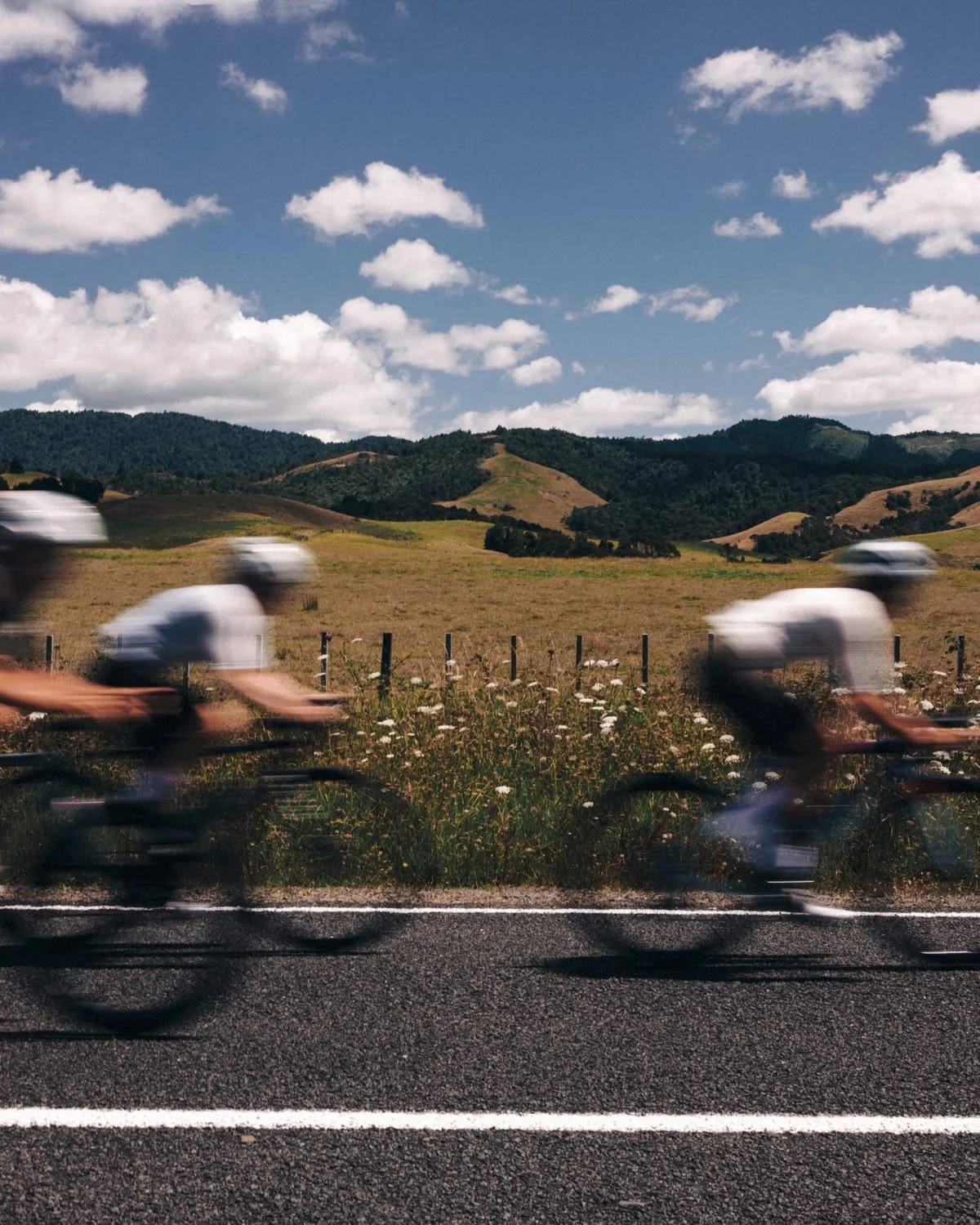
Cycling occupies much of the race and was strongly associated with finishing time in the review. That does not make riding as hard as possible the best choice. The same power can cost more in heat or fatigue. Combine power, perceived effort and bodily responses; an aerodynamic position must also be comfortable and sustainable. No FTP percentage is ideal for everyone.[1]
4. Brick workouts: learning to run after cycling
Transition changes mechanics and muscular demands when fatigue is already present. A brick combines consecutive disciplines, usually cycling and running. Use it to practice pacing, equipment and fueling, rather than simply accumulating fatigue. USA Triathlon provides practical applications; this does not establish a mandatory number of bricks or replace discipline-specific training.[5]
| Step | Brick example |
|---|---|
| Bike | 75 min |
| Last 10 min, within the 75 min | Approach planned race effort if appropriate |
| Transition | Safe equipment change; no rushing in traffic |
| Running | 10–15 min easy and gradually building |
5. You do not need a full 113 km rehearsal
A full rehearsal can require prolonged recovery and compromise subsequent sessions. Develop duration, technique and endurance through specific training and shorter combinations. One week may prioritize a long ride with a short run; another, a long run with better recovery beforehand. Preparation should build capacity without turning every week into a race.
6. Intensity: look at the whole week
Easy training helps accumulate work; demanding sessions develop specific capacities. Avoid automatically adding intensity across all three disciplines. The 80/20 rule is not universal: a 2025 meta-analysis of 13 studies and 348 endurance athletes found no significant overall superiority of one distribution in the main outcomes. Allocate effort according to experience, quality and recovery.[6]
7. Swimming: technique and endurance
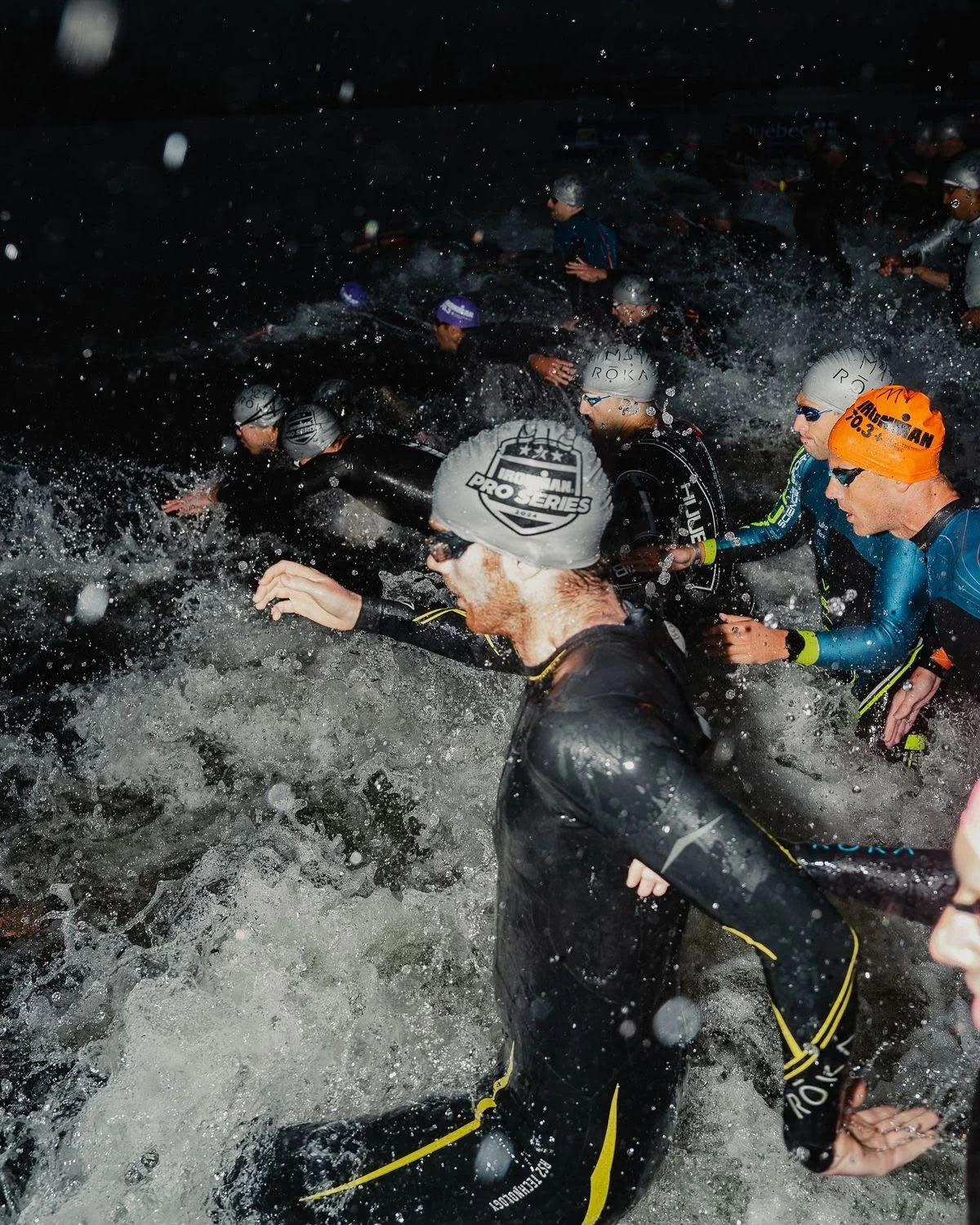
For swimmers with basic technique, the session below totals 1,600 m. Keep repetitions controlled rather than maximal. Start with 20–40 s recovery in the main set and adjust to preserve technique; recover as needed between drills. Efficiency helps you leave the water ready to ride. Open water requires supervised familiarization, sighting and safe conditions.
| Step | Prescription |
|---|---|
| Warm-up | 300 m easy |
| Technique | 6 × 50 m |
| Main set | 4 × 200 m comfortable; 20–40 s recovery |
| Cool-down | 200 m easy |
8. Cycling: power you can sustain
Combine progressively longer rides with structured work. FTP is a test-dependent estimate, not a perfect measurement of your physiological limit. In the 65 min session below, intervals should be demanding but repeatable. Use perceived effort and available data; reduce the load if technique and control deteriorate. Higher watts should not wreck the rest of the week.
| Step | Prescription |
|---|---|
| Warm-up | 15 min easy |
| Main set | 3 × 10 min at moderate-to-hard, sustainable effort |
| Recovery between intervals | 2 × 5 min easy |
| Cool-down | 10 min easy |
9. Running: build endurance without racing every session
Easy runs, pace sessions, long runs and bricks serve different purposes and need not all appear in the same week. An endurance example totals 70 min: 10 min easy, 50 min comfortable and 10 min easy to finish. This is not a personal-best test. Progress duration from a tolerable workload; there is no universal requirement to run the full 21.1 km before racing.
10. Carbohydrates: rehearse race fueling
Carbohydrate stores are limited. During prolonged efforts, plan the amount, type and digestive tolerance. The ranges below are general references depending on intensity, duration and prior meals. Glucose–fructose mixtures can be useful at higher intakes. Rehearse gradually; race day is not the time to try everything for the first time.[2]
| Approximate duration | General carbohydrate reference |
|---|---|
| Up to 60 min | Often unnecessary during the session |
| 1–2.5 h | 30–60 g/h |
| Over 2.5 h | 60–90 g/h, with established tolerance |
If 60 g/h has been tested and tolerated, a drink containing 30 g and a gel containing 30 g illustrate one possible combination. Check labels and count all sources. Fluid needs are assessed separately. Wilson’s review of ≥100 g/h found no clear additional experimental benefit over 60–90 g/h in the few comparative studies available; they do not resolve all demands of multi-day professional cycling. More is not automatically better.[3]
11. Hydration: avoid both shortage and forced excess
Heat, humidity, intensity and sweat losses change requirements. There is no universal hourly water or sodium dose. Excessive drinking can contribute to hyponatremia; taking sodium does not remove that risk. Consider thirst, tolerance, conditions and your rehearsed individual plan. Fluid and body-mass records can inform assessment, but a single weighing cannot precisely establish all losses.[1]
12. A possible week: distribute rather than pile up
The example below totals about 8 h 20 min including optional strength work, excluding travel and transitions. It only suits athletes already tolerating a similar load. Saturday and Sunday concentrate endurance: shorten Sunday or move the long run if the brick compromises recovery. Wednesday’s ride can be easy during weeks prioritizing another session.
| Day | Training |
|---|---|
| Monday | Rest or easy mobility |
| Tuesday | Swim 45 min + strength 30 min |
| Wednesday | Cycling 60 min |
| Thursday | Run 50 min + swim technique 35 min |
| Friday | Strength 30 min or rest |
| Saturday | Cycling 135 min + brick run 15 min |
| Sunday | Run 70 min if recovered |
Do not copy only the hours: consider sleep, work, travel, experience in each sport and recovery capacity. More sessions do not automatically make up for weak technique or inconsistency. Do not add this entire sample week on top of all the earlier examples; they are alternative ways to organize training.
13. Twenty weeks as a framework, not a guarantee
| Period | Priority |
|---|---|
| Weeks 1–4 | Assess technique, routine and tolerance; establish a base |
| Weeks 5–8 | Gradually develop endurance and duration |
| Weeks 9–12 | Integrate pacing and combined sessions |
| Weeks 13–16 | Rehearse strategy, equipment and fueling |
| Weeks 17–18 | Consolidate and assess recovery |
| Weeks 19–20 | Reduce load and race with managed fatigue |
This model assumes a base in all three disciplines. Beginners may need more time, particularly for water safety. Repeat or adapt phases according to response; do not automatically increase duration, intensity and frequency together. Persistent difficulty completing the current load calls for reassessment rather than mandatory calendar-based progression.
14. Tapering: reduce fatigue before the start
A 2023 meta-analysis included 14 endurance studies and found performance improvements with planned load reduction. Protocols reducing volume by 41–60% while maintaining intensity and frequency showed favorable results. This does not require every triathlete to cut exactly half. Preserve appropriate stimuli, reduce fatigue and avoid making up missed sessions with a huge workout close to race day.[4]
15. Track progress in context
Compare standardized swim sets, similar bike efforts, familiar running routes and responses after bricks. Record duration, distance, pace, power when available, perceived effort, fueling and recovery. Wind, heat and terrain change results. More watts alongside a worse run do not alone describe better preparation. Constant maximal testing is unnecessary.
16. Eight mistakes to avoid
- Assuming that completing each sport separately guarantees completing the combination.
- Riding above an intensity that still allows you to run afterward.
- Turning every session into a hard effort.
- Making every brick a full race simulation.
- Improvising fueling and hydration during the race.
- Copying professional volume without considering routine and experience.
- Neglecting water safety, sighting and supervision.
- Sharply increasing load to make up missed training close to race day.
17. Safety that fitness cannot replace
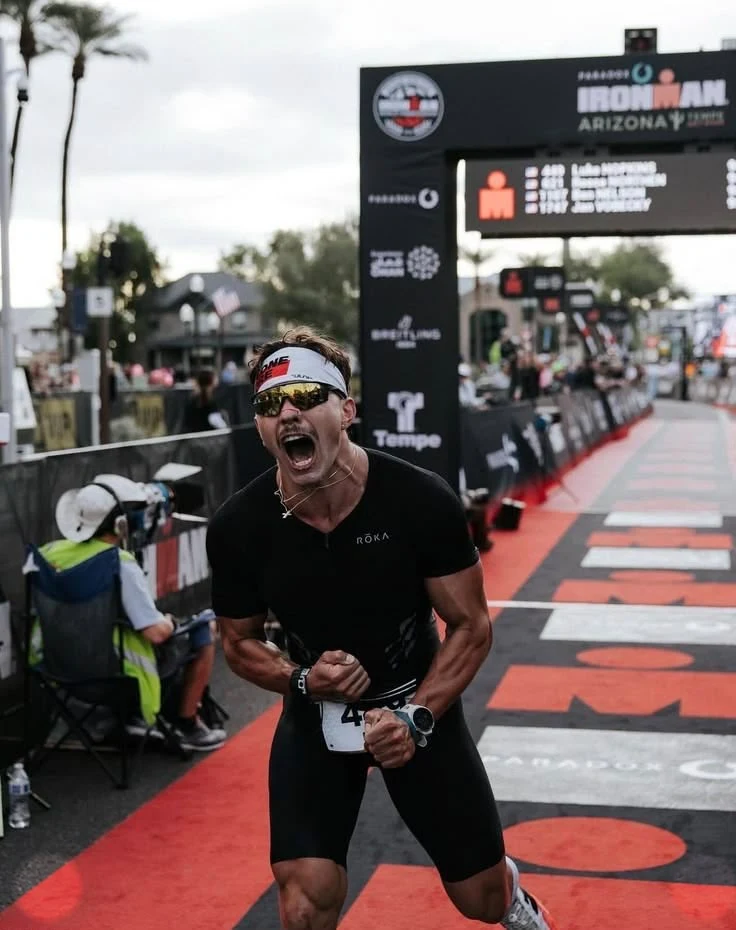
In the water, assess temperature, currents, visibility and support: do not train alone in open water. On the bike, wear a helmet, check equipment and practice cornering, braking and fueling somewhere safe. On the run, adapt effort to heat and fatigue. The finish photograph illustrates a triathlon event; it does not identify the distance raced or imply athlete partnership or endorsement of VETOR.
18. Where VETOR fits
A runner entering triathlon does not have the same needs as a cyclist still learning to swim. VETOR’s approach is to organize training around goals, history, disciplines, availability and progression. Record what actually happened and interpret the context. This is not a promise of automatic finishing-time prediction, laboratory thresholds or sensor-determined nutrition without implemented and validated features.
19. What science still cannot decide for you
No single volume, pace or number of bricks is proven ideal for everyone. Observations in trained athletes do not automatically transfer to beginners, women or older athletes. Apply principles and monitor individual response. The best plan supports consistent training, adjustments when needed and the capacity to keep running, rather than merely proving tolerance for suffering.
Prepare for your next goal with VETOR
Join the waitlist for VETOR updates and an approach to training guided by context, progression and goals.
References
- Performance, physiology, and determinants of success in IRONMAN® 70.3: A systematic review. Von Känel-Cordoba et al. (2026).PLOS ONE · 10.1371/journal.pone.0352506
- A Review of Carbohydrate Supplementation Approaches and Strategies for Optimizing Performance in Elite Long-Distance Endurance. Cao et al. (2025).Nutrients · 10.3390/nu17050918
- A Narrative Review of the High-Carbohydrate Fueling Revolution (≥100 g/h) in the Professional Peloton. Wilson (2026; online 2025).Sports Medicine · 10.1007/s40279-025-02372-6
- Effects of tapering on performance in endurance athletes: A systematic review and meta-analysis. Wang et al. (2023).PLOS ONE · 10.1371/journal.pone.0282838
- How to Use Brick Workouts in Triathlon Training. John Hansen (2021).USA Triathlon
- Which Training Intensity Distribution Intervention will Produce the Greatest Improvements in Maximal Oxygen Uptake and Time-Trial Performance in Endurance Athletes? Rosenblat et al. (2025).Sports Medicine · 10.1007/s40279-024-02149-3
- Official distances: 1.9 km swim, 90 km bike and 21.1 km run.IRONMAN
Educational content; not a substitute for medical or nutritional assessment or individual coaching. Sessions are adaptable examples without guaranteed outcomes or readiness. IRONMAN is a trademark of its respective owners; this content is independent.