
High-performance cycling: why FTP is not everything — and how to build power, durability and efficiency
Your best power when rested tells only part of the story. In long races, gran fondos, triathlons and road cycling, performance also depends on how much power you can still produce after two, three or four hours. Research is increasingly focusing on this ability: durability.

It's easy to understand why modern cycling has become obsessed with numbers. Watts. Watts per kilogram. FTP. VO₂max. Heart rate. Cadence. Training Stress Score. Time in zone. All provide useful information. But imagine two cyclists. Both have a 300 W FTP. Both can produce approximately the same power during a test when rested. After three hours of pedaling, however, the first one can still sustain 280 W for a significant period.
The second can barely maintain 240 W. At the beginning of the test, they looked physiologically similar. In the end, they are completely different athletes. This ability to preserve performance after accumulating work has been called durability, or durability/fatigue-resistance. A study published in 2025 evaluated well-trained amateur cyclists performing five- and 20-minute tests, first rested and then after accumulating 1,000 kJ of work. Power dropped by approximately 10% in both tests when performed fatigued — and this drop was not significantly related to VO₂max or relative FTP.[1]
This creates a much more interesting question for training: not just “what is your FTP?”, but “how much of your FTP is still available when you really need it?”
FTP is still useful — it just doesn't tell the whole story
FTP is widely used in cycling because it offers a practical reference for setting training intensity. A test estimates your reference power, which helps define training zones. The problem begins when that number is treated as a complete description of your ability. A race does not take place in a laboratory after 48 hours of rest.
It happens after: climbs; attacks; wind; accelerations; hours of riding; changes of pace; heat; food; muscle fatigue. Two people can present exactly the same initial test and respond completely differently after accumulating work. In the 2025 durability study, participants lost an average of 10.1 ± 6.5% of power in the 20-minute test and 10.8 ± 7.8% in the five-minute test after the fatigue protocol. More importantly: this resistance to a drop in performance seemed to behave as a characteristic partially independent of traditional metrics.[1]
This means that performance can be thought of in at least two dimensions: how much you can produce fresh and how much of that capacity remains available after working.
A cycling race is a competition against deterioration
Imagine a three-hour test. In the first 30 minutes, almost every trained athlete can produce good numbers. The race is still relatively organized. The legs are fresh. Glycogen is relatively preserved. Body temperature hasn't risen that much yet. The difference starts to appear later. Who continues to climb well? Who can still respond to acceleration?
Who maintains aerodynamic position? Who can produce power after the last climb? Who can still sprint at the finish? This is part of what durability tries to represent. Another 2025 study compared amateur cyclists of different competitive levels. After the same fatigue protocol, the most successful cyclists lost approximately 6.5% of their 20-minute power, while the least successful cyclists experienced a drop of approximately 12.5%.[2]
This study does not prove that improving durability alone will make someone a winner. Samples are limited and the area is still evolving. But it reinforces something that experienced cyclists have recognized for decades: the race is often decided by what you can still do after all the previous work.
Your best watt may be less important than your late watt
Imagine: Cyclist A FTP: 320 W. After three hours: 20 minutes at 250 W. Cyclist B FTP: 300 W. After three hours: 20 minutes at 270 W. Who has the best FTP? A. Who could be more dangerous at the end of a given race? Possibly B. This is one of the reasons why completely rested tests can overestimate what will actually be available in competition. It doesn't mean we should stop running fresh tests.
They remain useful for tracking maximum or near-maximum capacity. But we can also start to observe: how much this capacity deteriorates after a certain amount of work. This change expands the way of monitoring evolution.

Durability is not simply “cycling longer”
It would be easy to conclude: “Then just do long rides.” Long rides probably play an important role. But durability is the result of several factors. Aerobic capacity. Economy. Muscular capacity. Energy availability. Thermoregulation. Experience. Effort distribution. Strength. Volume tolerance. And ability to recover from repeated acceleration. You can ride four hours slowly every week and still not necessarily improve your ability to produce relevant power after four hours.
There is a difference between: surviving time and performing after time. Training needs to gradually bring these two things closer together.
When to add intensity to the long ride
Easy, long rides have enormous value. They help to accumulate volume at a relatively controlled cost. But at certain moments in preparation, especially for long tests, it may be useful to introduce quality work after some accumulated fatigue. Imagine starting with: 2h30 predominantly controlled. And finish with: 3 × 10 minutes at previously planned intensity.
Now the athlete is not just training his power. You are training your ability to express it after you have already worked. This shouldn't happen every long ride. Nor should it start too early. But it can work as a specific progression. First you develop the capacity. Then you learn to access it tired.
Training rested is still essential
There is an opposite error. After understanding durability, the athlete begins to do all important sessions tired. Breaks after three hours. Strength after a long ride. Sprints at the end of it all. That would also be a bad interpretation. To increase your ceiling, many sessions need to be held in relatively good conditions. You need to be able to produce: more power; more strength; more speed.
If you are constantly fatigued, you may never be able to adequately stimulate that ceiling. A complete program may alternate: sessions to increase fresh capacity and sessions to preserve capacity under fatigue. Both are important.
Polarized, pyramidal or threshold?
This is another practically religious debate in cycling. Some argue: polarized training. Very easy. Not very moderate. Some extremely intense work. Others use pyramidal distribution. Very easy work. Less than moderate amount. Even less high intensity. Others spend longer periods close to the threshold. Which is better? A large systematic review and meta-analysis published in 2025 included 41 studies, 81 training groups and 797 trained cyclists.[3]
All models analyzed produced improvements in VO₂max and time trial performance. And there was no statistically significant difference between polarized and non-polarized training. This result is extremely important because it removes a false obligation. You do not need to belong to a “zone school”. You need to organize the intensity according to: objective; phase; available volume; level; recovery; and test demands.
The perfect model may not exist
In the meta-analysis, longer interventions were associated with greater improvements in VO₂max and performance. There was no significant association between weekly or total volume and the magnitude of gains within the included studies. This does not establish a universal cap on hours nor does it demonstrate that increasing volume is useless for an individual. The result reinforces the need for context: consistency, initial level, progression and quality of sessions. Before asking “should I do 80/20?”, ask if your week allows you to perform and recover important workouts.[3]
Zone 2 shouldn't become a religion either
The recent growth of interest in Zone 2 has merit. Many athletes actually do too much moderate work. They accumulate fatigue without creating space for high quality intensity. But there is a curious consequence. Some people have come to treat any intensity above Zone 2 as unnecessary. This is equally problematic. Competitive cycling requires: attacks; climbs; accelerations; sprints; responses above the threshold.
An athlete needs to build a base. But you also need to be capable when the pace is no longer comfortable. Easy work allows you to accumulate. Intense work increases certain limits. Specific training connects both to competition.
A good cyclist has a range of power capacities
When someone says: “My power is 280 W” it practically means nothing without context. How long? Five seconds? One minute? Five minutes? Twenty? An hour? After three hours of testing? Each duration represents a different demand. A sprinter can possess extraordinary five-second power. A climber may have a higher W/kg ratio for 20–40 minutes. An extreme endurance athlete may have an enormous capacity to sustain submaximal power for many hours.
Therefore, reducing performance to a single number limits the prescription. Cycling is a profile of capabilities, not a single ability.
Off-the-bike strength can also improve cycling
There is a persistent belief that cyclists should avoid heavy weight training because: “mass makes you slow” or “if you want to pedal better, pedal.” The recent evidence is more interesting. A systematic review with meta-analysis published in 2025 analyzed 17 studies and 262 cyclists, including five- to 25-week interventions with heavy strength training. Compared to cycling alone, strength training had a favorable effect on: cycling efficiency; anaerobic power; and performance in cycling tests.[4]
There was no significant improvement in VO₂max, threshold or several other metabolic markers. The overall certainty of the evidence was considered low, therefore the results should be interpreted with caution. This result is extremely interesting. You can get better at cycling without necessarily increasing your VO₂max.
Strength can improve how much it costs to produce a watt
Imagine two cyclists producing: 250 W. One needs to recruit a greater percentage of his muscular capacity for each pedal stroke. The other has a greater reserve of strength. In theory, increasing strength can make a given power output relatively less muscularly demanding. The meta-analysis found improvements in cycling efficiency and anaerobic power, offering a plausible explanation for some of the observed improvement in performance.[4]
This doesn't mean cyclists need to do bodybuilding. Nor do they need to maximize squats. Strength is a tool. The goal remains to pedal better.
The problem with bodybuilding-style strength training during a high-volume cycling phase
Consider a week with: 12 hours of cycling. Four-hour long ride. Intervals. And another leg session with: 20 sets until failure. Weight training can be excellent in isolation. But perhaps it is incorrectly inserted. For a cyclist, strength training needs to respect: bike volume; season phase; priority of the week; and recovery. During a given phase, two strength sessions may make sense.
Close to a competition, perhaps a maintenance session will be enough. The question is not: “does strength work?” It’s: “how to fit it in without compromising what it should improve?”
Cadence is also not a magic number
Many cyclists become obsessed with finding a perfect cadence. 85rpm. But the best cadence depends on: power; land; tactics; available gear; neuromuscular characteristics; and individual preference. Climbs may require a different strategy than a flat time trial. A sprint is different from an endurance ride. Therefore, cadence should be interpreted along with the task.
Training different relationships between torque and speed can be useful. But trying to maintain an arbitrary frequency regardless of context may just create another pointless rule.
External power does not show the entire internal cost
Two people can produce 200 W. For one: heart rate 130. RPE 3. For another: HR 160. RPE 7. The power produced is equal. Not the cost. And even for the same person: 200 W on a cool morning does not necessarily represent the same cost as 200 W after three hours in the heat. This is why training based solely on watts also has limitations. Power is excellent because it shows external work.
But we need to cross it with: perception of effort; heart rate when available; duration; historical; and context. The number gains meaning when we know how much it cost to produce it.
Drift is information
Imagine starting a two-hour ride at: 200 W. First hour: average heart rate 135. Second hour: 200 W again. Average heart rate 148. Power remained stable. But the internal system had to work harder to sustain it. There are several possible reasons: heat; dehydration; fatigue; reduction in plasma volume; low energy availability; or simply too high an intensity for that duration.
This type of decoupling can provide context about durability. It doesn't need to become an absolute indicator. But it helps to understand that: performance is not just watts.
Feeding during the ride also changes the performance you can preserve
A long workout performed undernourished doesn't just test your physical capacity. It also tests its ability to produce power with reduced energy availability. This may be intentional in specific contexts. But it could also simply be a mistake. A 2025 study of recreationally active men evaluated three hours of cycling while participants consumed 90 g of carbohydrate per hour, spread out every 15 to 30 minutes. The form of distribution did not produce relevant differences in physiological responses, oxidation of substrates or gastrointestinal discomfort in that protocol.[5]
This study does not mean that everyone should consume 90 g/h. Even if this amount is ideal for every session. But it shows a useful principle: supply strategy is also part of the ability to sustain performance. You should not automatically interpret a late drop in power as a lack of conditioning if the athlete simply did not adequately fuel the effort.[5]
Durability is physical, but also strategic
Imagine a cyclist with excellent ability. For the first 30 minutes, you feel great. Attack. Pull squad. Rises above the threshold several times. Three hours later, it loses performance. Was it low durability? Perhaps. Or maybe you misallocated your capacity. Pacing influences what is left after. Therefore, learning to control intensity is also part of the preparation. The athlete needs to know: when to use power; when to save; when to accept losing position; and when acceleration really matters.
On the road, the best physiological number doesn't automatically win. Decisions also consume energy.
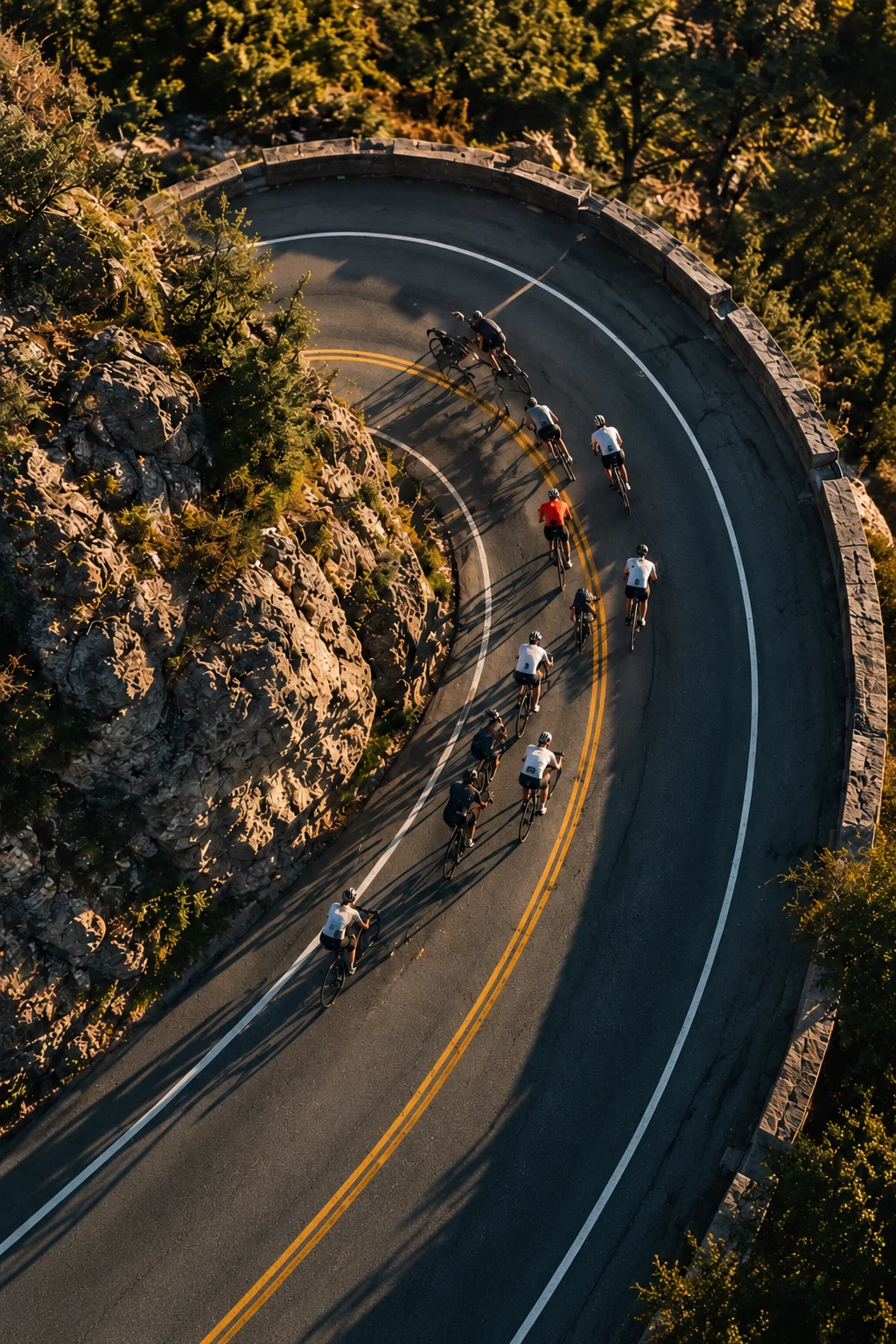
Training needs to reproduce the competitive problem
If your race has: three relatively stable hours followed by a final climb of 20 minutes, then eventually the program should test your ability to produce power in this context. Not necessarily every week. But at some point. If your modality requires: repeated efforts lasting one minute; sprints; short climbs; so continuous long rides are not enough. If the objective is: time trial, sustaining constant power may be more important.
This seems obvious. But many programs are still structured primarily by capabilities that are easy to measure, rather than by capabilities that the competition actually demands.
How to train durability without destroying the week
Progression can start simple. First: we increase volume tolerance. After: we introduce intensity blocks at the end of moderate sessions. Later: we bring the session closer to competitive demand. A cyclist can progress, for example, from a completely easy long ride to a ride with some controlled blocks at the end. These blocks can then increase in duration. Or intensity.
Or occur after a greater amount of work. But we don't need to increase all the variables at the same time. This is the central point. Durability is built progressively. Not brutally tested every week.
Five sessions to adapt to your goal
RPE stands for perceived exertion on a scale of 0 to 10. Here, 2–3 is comfortable; 5–6 is moderate and controlled; 8 is strong but repeatable. These ranges do not exactly equate to FTP percentages. Use the meter as a reference, if you have one, and adjust to the effort of the day.
| Goal | Complete example | Tip for getting the dose right |
|---|---|---|
| Build base · 45 min | 10 minutes light + 30 minutes comfortable + 5 minutes light. RPE 2–3/10. | You must speak in complete sentences. If the climb is very demanding, use lighter gear or choose another route. |
| Aerobic power · 55 min | 15 min warm-up + 4 × 4 min at RPE 8/10, with 3 min easy between blocks + 15 min easy. | Maintain strong, repeatable effort. If the last block collapses, reduce the initial intensity or just do three. |
| Sustained pace · 60 min | 15 min easy + 2 × 12 min at RPE 6–7/10, separated by 6 min easy + 15 min easy. | It serves as an alternative to breaks, not as an extra obligation. Finish without needing to sprint to reach the number. |
| Durability · 120 min | 90 min easy + 2 × 8 min at RPE 5–6/10, with 4 min easy between blocks + 10 min easy. | Only for those who can already tolerate two easy hours. Fuel up early; remove the blocks if the effort becomes too much. |
| Recovery · 30 min | Very light 30 min at RPE 1–2/10, without chasing average speed. | Resting completely is also an option. Recovery ride doesn't need to become another load goal. |
Strength: A Short Off-Bike Example
For those who already know the moves: warm up for 5–10 minutes; do a squat or leg press for 2–3 sets of 5–8 reps, a hip thrust for 2 sets of 6–8, and a unilateral exercise for 2 sets of 6–8 per side. Rest 2–3 minutes on the main exercises and finish with about 2–3 repetitions possible, maintaining technique. The load depends on experience, not a fixed weight.
If you are starting out in bodybuilding, use fewer sets and light loads to learn how to perform with guidance. The example does not reproduce a specific heavy-force meta-analysis protocol. Muscle pain that impairs the next ride cycle indicates that the dose or weekly adjustment needs to change.
A possible progression to the end of the long ride
| Step | Session | Criteria for advancing |
|---|---|---|
| 1 · Consolidate | Repeat the long easy for the duration you can already tolerate. | End controlled and regain your usual disposition. |
| 2 · Try | Keep it full length and replace 8 easy minutes with 8 moderate minutes near the end. | Breathing, posture and effort remain stable. |
| 3 · Repeat | Consolidate the previous step for more sessions, without increasing everything. | The following training maintains quality. |
| 4 · Enlarge | If you are recovering well, use 2×8 min moderate, with 4 min light in between. | No major drop in execution; If there is, go back one step. |
The stages do not necessarily correspond to weeks. If you increased the total time, maintain the intensity; if you included blocks, preserve the duration. Maximum tests after fatigue are different from these examples and deserve planning with a coach.
Tips that make a difference on the road
- Take intervals on a roller, closed circuit or safe and predictable stretch; avoid intense efforts on descents, intersections and traffic.
- Compare training in similar conditions: route, wind, temperature, food and meter calibration, if applicable.
- Don't chase arbitrary cadence. Use gears that allow you to pedal with control and without discomfort.
- Plan water and food before leaving. Test the strategy in training, instead of debuting products in the race.
- Record duration, 0–10 effort, feeling in the final stretch, and recovery the next day. Without power, that already informs the decision.
Example of a week for an intermediate cyclist
Educational example for a healthy adult who already cycles four times a week and tolerates around four to five hours on the bike. Adjust the duration to the volume you already support. The sessions below illustrate a general phase; They are not an individual prescription nor protocols that the aforementioned studies tested as a set.
| Day | Session | How to run |
|---|---|---|
| Monday | Rest | Light walking or mobility if desired. |
| Tuesday | Intervals · 55 min | 15 min easy + 4 × 4 min hard, with 3 min easy between blocks + 15 min easy. RPE 8/10, no sprint. |
| Wednesday | Easy ride · 45 min | RPE 2–3/10; conversation in complete sentences. If Tuesday's training took a toll, rest. |
| Thursday | Strength · 30–40 min | Few exercises, good technique and 2–3 reps in reserve. It's not a session to failure. |
| Friday | Rest | Protect the quality of the weekend. |
| Saturday | Long easy · 90–150 min | Use the usual duration. RPE 2–3/10, planned nutrition and hydration. |
| Sunday | Easy ride · 45 min | Keep it light. Swap for rest if there is residual fatigue. |
That’s 3:55–4:55 on the bike, plus strength. Those who already tolerate more volume can prolong an easy ride, without simultaneously increasing the intervals. A second strength session requires rearranging the week; does not need to be added automatically.
In the specific phase, a moderate finish can replace part of Saturday's easy long ride, only when recovery is good. It now counts as a demanding second session. Reduce the dose on Tuesday if necessary and keep Sunday really light.
Five common mistakes in performance cycling
- Treating FTP as synonymous with performance. Also notice how your power changes over the course of comparable sessions.
- Turn every ride into moderate effort. Preserve space to recover and execute strong sessions well.
- Seek more volume automatically. The meta-analysis found no significant association between volume and gains in the included studies; this does not define a universal cap on hours.
- Ignore force. It can help efficiency and performance, as long as your dose fits into the recovery available.
- Always train rested or always tired. Combine quality sessions with gradual exposure to the demands of the test, depending on the phase.

How to apply this tomorrow
Choose a recent long session. Don't just look at: distance; time; or medium power. Ask: What happened to my performance in the final part? If your power has dropped a lot, try to understand why. Was it: excessive initial intensity? food? heat? new volume? Fatigue of the week? or lack of capacity to sustain the effort? Then choose a variable to attack. Maybe you need: more easy volume.
Maybe from: intervals. Maybe from: strength. Maybe from: better nutritional strategy. Maybe: training power after accumulated work. There is no reason to add everything simultaneously.
VETOR and the difference between a number and a trend
An isolated workout shows what you did today. A history lets you compare sessions over time. At VETOR, the proposal is to give direction to training and bring together planning, sessions and history to support this monitoring. For cycling, also write down how the ride felt, how much work came before and how the recovery was. External metrics can enrich this conversation when available.
A performance app shouldn't increase load just because the athlete completed the workout
Completing a 90-minute session does not mean, in itself, that the next one should last 100. If the effort was much greater than planned or the power dropped, it is worth investigating heat, food, sleep and the week's load. This is a decision logic for the athlete and their coach: maintaining the dose or redistributing intensity can also be a good choice. Progression must consider the response to training, not just its completion.
The same goes for FTP
Imagine that a cyclist has increased his FTP. Excellent. But on long rides: late drop remains huge. Perhaps the priority for the next block is not to increase FTP further. Perhaps it is developing the ability to maintain a greater percentage of this power after accumulated work. Another athlete has excellent durability but a relatively low ceiling. In this case, the problem may be the opposite.
This is the value of thinking about profiles. Two athletes with the same goal may need different programs because they lose performance in different ways.
High performance is knowing what to keep
Not all capacity needs to be maximized simultaneously. Maybe FTP is fine. Durability needs to improve. During another block, durability can only be maintained while anaerobic power receives more attention. Then, closer to competition, specificity grows. That's exactly what periodization should do: change priorities without completely abandoning the rest. Even cycling coaches demonstrate using this logic in practice. In a survey of 117 coaches published in 2025, 94% reported changing intensity distribution depending on the stage of the season.[6]
There's no reason a week in January should feel exactly like a pre-exam week.
Conclusion
Modern cycling has more data than ever before. But more data doesn't automatically mean better decisions. FTP continues to be useful. VO₂max continues to be important. Power remains one of the best ways to measure external work. But none of these numbers alone explains what happens after hours of competition. Recent studies indicate that durability may represent a partially independent dimension of performance, and more successful cyclists seem to preserve their power better after accumulating work.
At the same time, a large meta-analysis shows that there is no strong evidence that a single distribution model—polarized or not—is universally superior; consistency and proper organization of intensity seem to be more important than following a specific formula. And strength training can improve efficiency, anaerobic power, and cycling performance even when VO₂max remains largely unchanged.
The high-performance question, therefore, should not just be: “How many watts can I produce?” It should be: “How many watts can I still produce when the test really starts to get difficult?” That's where cycling stops being just about ability. And it becomes resistance to loss of capacity. VETOR — DON’T GUESS. His best number doesn't tell the whole story. What matters is: how much you produce; how much does it cost; how much you can repeat; and how much remains available after working.
VETOR seeks to connect prescription, progression, history, frequency, limitations and response to training to transform isolated sessions into a performance process. Don't just pursue FTP. Build the engine. Build strength. Build efficiency. And above all: build the capacity to continue producing when others begin to lose power. DON’T GUESS.
Give direction to the next ride.
Discover VETOR's proposal and follow the app's news. Planning and history help you see beyond isolated training.
References
- Durability after accumulated workBarsumyan et al. BMC Sports Science, Medicine and Rehabilitation, 2025;17:192. DOI: 10.1186/s13102-025-01238-8.
- Durability and competitive performanceBarsumyan, Soost and Burchard. Frontiers in Sports and Active Living, 2025. Study of 14 cyclists. DOI: 10.3389/fspor.2025.1530162.
- Distribution of intensity, duration and volumeCove et al. Journal of Science and Medicine in Sport, 2025;28(5):423–434. Published online in December 2024. DOI: 10.1016/j.jsams.2024.12.005.
- Strength training for cyclistsLlanos-Lagos, Ramirez-Campillo and Sáez de Villarreal. European Journal of Applied Physiology, published online in July 2025. DOI: 10.1007/s00421-025-05883-2.
- Distribution of carbohydrate intakeJones et al. European Journal of Sport Science, 2025;25(7):e12336. DOI: 10.1002/ejsc.12336.
- How coaches distribute intensitySmith et al. A survey exploring the programming practices of cycling coaches: How are intensity zones and intensity distribution models used? International Journal of Sports Science & Coaching, 2025.
Educational content. Training examples are editorial suggestions, not individual prescriptions or guarantees of results. Tailor them to your history, health and recovery with professional support when needed. Illustrative images provided by the person responsible and edited with AI.